
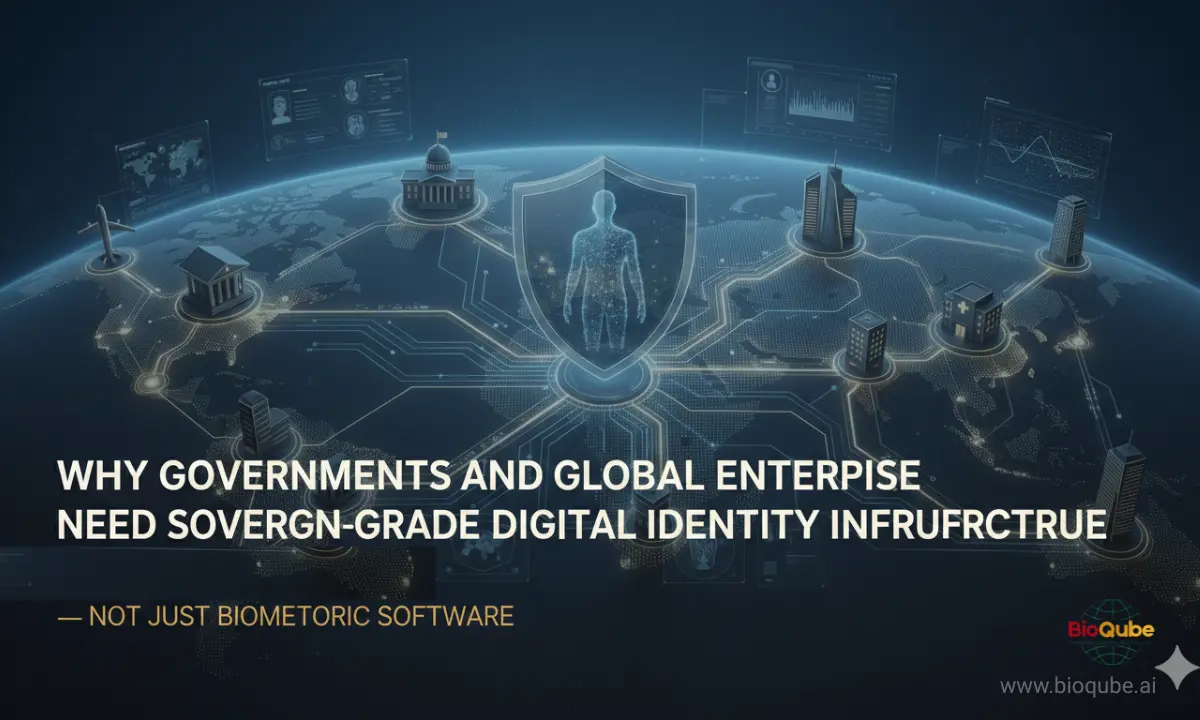
Digital Identity Infrastructure: In 2026, identity has become the most critical layer of national security, economic stability, and digital trust. Yet most of the world is still attempting to solve twenty-first-century identity threats using twentieth-century biometric models.
Face scanners, fingerprint devices, and isolated KYC platforms were designed for controlled environments. They were never built to defend against deepfake fraud, cross-border crime, synthetic identities, or large-scale data manipulation.
This mismatch between threat and technology is now one of the greatest strategic risks facing governments and enterprises alike.
The problem is not that biometrics are failing. The problem is that biometrics were never designed to function as national or global trust infrastructure. They were built as tools. What the modern world requires is a sovereign-grade identity platform.
Table of Contents
The limits of device-led biometrics
Most biometric deployments still depend on specialized hardware; cameras, scanners, kiosks, or proprietary terminals. While these tools may work in isolated settings, they introduce three fundamental weaknesses when used at national or enterprise scale.
First, they limit reach and inclusion. Every new border checkpoint, bank branch, hospital, or government office requires physical installation and maintenance. This makes it expensive and slow to expand coverage, particularly in rural or low-infrastructure regions.
Second, they fragment identity. When biometric data is captured by different devices using different formats, governments and enterprises cannot create a single, trusted view of a person across agencies, systems, and borders.
Third, they increase security risk. Hardware-bound systems are easier to spoof, tamper with, and exploit. In an age of AI-generated faces, voices, and fingerprints, device-centric biometrics no longer provide sufficient protection.
What worked for physical access control does not work for digital governance.
Identity is Now a Strategic and Geopolitical Asset
Today, identity is no longer just about verifying who someone is. It determines who can cross a border, receive public benefits, open a bank account, access healthcare, vote, or enter a country. It sits at the intersection of national security, financial integrity, and human rights.
Governments are now being targeted not just by criminals, but by organized fraud networks and hostile actors who exploit weak identity systems to move money, people, and influence across borders. Enterprises face the same threat as synthetic identities and deepfakes undermine KYC, AML, and transaction security.
In this environment, identity systems must be:
- Real-time, not batch-based
- Cross-border, not siloed
- Fraud-resistant, not device-dependent
- Citizen-centric, not vendor-controlled
This is the difference between biometric software and sovereign-grade identity infrastructure.
What Sovereign-grade Digital Identity Actually Means

A sovereign-grade identity platform does not belong to a device, a vendor, or a single application. It belongs to the institution that governs trust.
It means that biometric identity can be created, verified, and authenticated from any approved device — smartphone, tablet, CCTV camera, web portal, or border checkpoint — without compromising security.
It means that identity data is cryptographically protected, auditable, and governed by national policy rather than proprietary formats.
It means that one person has one trusted digital identity that can be used across immigration, healthcare, banking, education, and public services without duplication, fraud, or data leakage.
It also means that the system can scale from a remote village clinic to an international airport without changing its security posture.
This is the model BioQube was built to deliver.
How BioQube Delivers Sovereign-grade Identity
BioQube is not a face recognition or fingerprint product. It is a decentralized, AI-powered, multifactor digital identity platform designed to operate across borders, devices, and populations in real time.
BioQube combines five biometric modalities – face, fingerprint, palm, voice, and eye; into a single secure identity layer, ensuring that no single factor can be exploited or forged. Its hardware-agnostic architecture allows identity verification from any approved device, including smartphones, laptops, IP cameras, and CCTV systems. This enables governments and enterprises to deploy secure identity services anywhere, without costly device lock-in.
BioQube’s Web3-enabled and decentralized framework ensures that identity ownership, access control, and auditability remain in the hands of the institution, not the vendor. This makes the platform suitable for national ID programs, visa and immigration systems, border security, healthcare access, financial inclusion, refugee and Asylum management, and secure digital transactions.
By unifying biometric identity into one trusted infrastructure layer, BioQube enables real-time verification, eliminates duplication and fraud, and supports cross-agency and cross-border interoperability.
The Future Belongs to Identity Infrastructure
The next decade of digital transformation will not be defined by who sells the most biometric devices. It will be defined by who controls trust.
Governments that continue to rely on fragmented, hardware-centric identity systems face rising fraud, higher operational costs, and declining public confidence. Enterprises that depend on single-factor or device-bound verification remain vulnerable to deepfake attacks, compliance failures, and financial crime.
Sovereign-grade digital identity infrastructure is no longer optional. It is the foundation of digital sovereignty, national security, and economic resilience.
BioQube provides that foundation, enabling governments and global enterprises to protect people, borders, and transactions in a world where identity has become the new frontline of security.
Latest Insights!
- Why Governments and Global Enterprises Need Sovereign-Grade Digital Identity Infrastructure – Not Just Biometric Software
- The Sovereign Identity Revolution: How BioQube.AI Is Decentralizing Global Digital Trust
- 5 Common Biometric Myths Debunked | Truth About Biometric Security
- The Future of Face Recognition Technology
- 5 Benefits of Using Biometrics as Passwordless Authentication
FAQs (Frequently Asked Questions)
What is sovereign-grade digital identity infrastructure?
Sovereign-grade digital identity infrastructure is a secure, government-controlled platform that enables real-time biometric identity verification across borders, agencies, and digital services without dependence on specific hardware.
How is sovereign digital identity different from biometric software?
Biometric software verifies identity on a single device, while sovereign-grade digital identity connects multiple biometric factors across systems, ensuring national-level security, data sovereignty, and fraud prevention.
Why do governments need decentralized digital identity systems?
Decentralized digital identity protects citizen data, prevents identity fraud, and gives governments full control over how biometric information is stored, accessed, and verified.
How does digital identity improve border security and immigration?
Digital identity enables real-time, multifactor biometric verification at border checkpoints, reducing impersonation, illegal entry, and document fraud.
Why is hardware-agnostic identity verification important?
Hardware-agnostic identity allows verification from any approved device, such as smartphones, CCTV, or web platforms, making national and enterprise identity systems scalable and cost-efficient.


