
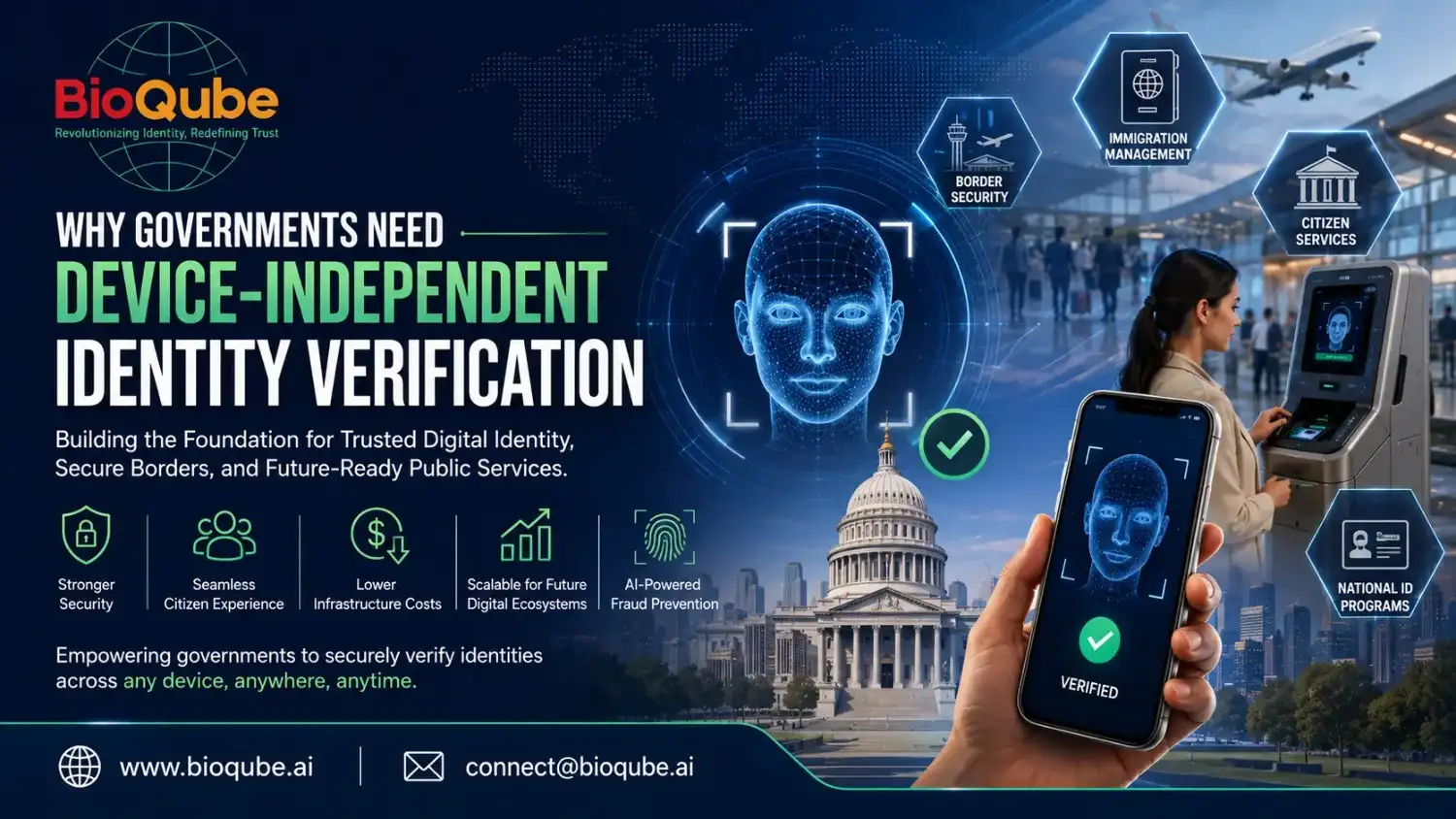
Governments worldwide are accelerating investments in digital identity, smart border modernization, citizen-centric services, and Digital Public Infrastructure (DPI). Yet many public-sector identity systems remain dependent on proprietary hardware, fragmented databases, and legacy verification processes that limit scalability, interoperability, and accessibility.
At the same time, government agencies face mounting challenges—from identity fraud and deepfake attacks to increasing traveler volumes and growing citizen expectations for seamless digital services.
The solution lies in a new approach to identity management: Device-Independent Identity Verification.
By enabling secure identity verification across smartphones, tablets, laptops, desktops, kiosks, IP cameras, CCTV systems, border checkpoints, and government portals, device-independent identity verification helps governments strengthen security, reduce operational costs, improve citizen experiences, and accelerate digital transformation.
When combined with AI-powered identity verification, multifactor biometrics, real-time analytics, and hardware-agnostic deployment, it becomes the cornerstone of a trusted and future-ready digital identity ecosystem.
Table of Contents
The Identity Challenge Governments Can No Longer Ignore
Identity is the foundation of modern governance.
Every interaction between governments and citizens depends on establishing trust.
Whether processing visa applications, securing borders, distributing social benefits, managing healthcare access, issuing national IDs, or enabling digital public services, accurate identity verification is essential.
However, traditional identity systems are struggling to keep pace with modern demands.
Governments Today Face Multiple Challenges
- Rising identity fraud and synthetic identities
- AI-generated deepfake attacks
- Increasing pressure on border and immigration operations
- Fragmented identity systems across agencies
- High infrastructure and maintenance costs
- Citizen demand for remote and mobile-first services
- Growing regulatory and compliance requirements
As digital services expand, governments require identity verification systems that are secure, scalable, interoperable, and accessible from anywhere.
What Is Device-Independent Identity Verification?
Device-independent identity verification refers to the ability to authenticate an individual’s identity securely across multiple devices and environments without requiring dedicated biometric hardware.
Instead of relying on specific scanners or proprietary terminals, identity verification can occur through:
- Smartphones
- Tablets
- Laptops
- Desktop computers
- Government service portals
- Self-service kiosks
- Airport eGates
- IP cameras
- CCTV systems
- Border control checkpoints
The identity remains consistent regardless of the device used.
This approach enables governments to build flexible digital identity ecosystems while maximizing existing infrastructure investments.
Organizations exploring this evolution should understand the growing importance of a hardware-agnostic biometric platform, which allows secure verification across diverse devices and operational environments.
Related Reading:
https://bioqube.ai/blog/hardware-agnostic-biometrics/
Why Legacy Identity Systems Are Becoming Obsolete
For decades, identity programs were built around dedicated infrastructure.
While effective in the past, these systems create significant operational limitations today.
The Hidden Costs of Device-Dependent Identity Systems
| Challenge | Impact |
|---|---|
| Dedicated Hardware Requirements | High capital expenditures |
| Proprietary Technologies | Vendor lock-in |
| Infrastructure Dependency | Limited scalability |
| Hardware Maintenance | Increased operating costs |
| Fragmented Databases | Poor interoperability |
| Physical Enrollment Requirements | Reduced accessibility |
| Upgrade Complexity | Slower innovation |
The result is an identity ecosystem that becomes increasingly expensive to maintain while delivering less flexibility over time.
Governments need a model that scales with citizen needs, technological advancements, and future digital service requirements.
The Rise of Digital Public Infrastructure (DPI)
Around the world, governments are investing in Digital Public Infrastructure (DPI) as the foundation for economic growth and digital inclusion.
DPI typically consists of three interconnected pillars:
Digital Identity
Trusted identity verification and authentication.
Digital Payments
Secure financial transactions and benefit distribution.
Data Exchange
Secure information sharing between agencies and institutions.
Without a trusted identity layer, the entire ecosystem becomes vulnerable to fraud, inefficiency, and poor adoption.
Device-independent identity verification strengthens the identity layer by enabling secure authentication across every citizen interaction.
Why Governments Are Investing in Device-Independent Identity Verification
1. Strengthening National Security
Identity verification is one of the most important components of national security.
Government agencies must continuously defend against:
- Identity fraud
- Illegal border crossings
- Organized crime
- Human trafficking
- Terrorism-related threats
- Synthetic identity attacks
AI-powered identity verification helps detect suspicious activities in real time while ensuring stronger identity assurance across multiple touchpoints.
2. Accelerating Border and Immigration Modernization
Global traveler volumes continue to grow.
Modern border agencies must simultaneously improve security and reduce processing times.
Today’s traveler journey includes multiple verification stages:
- Visa Application
- Airline Check-In
- Airport Security
- Immigration Checkpoints
- Automated eGates
- Arrival Processing
Device-independent identity verification enables a single trusted identity throughout the entire journey.
Organizations modernizing border operations should also explore how biometric border security systems are reshaping global travel.
Related Reading:
https://bioqube.ai/blog/how-biometrics-enhance-border-security/
Governments implementing next-generation immigration strategies can also benefit from modern Immigration Solutions that integrate biometric identity verification throughout the traveler lifecycle.
Related Solution:
https://bioqube.ai/solutions/immigration/
3. Reducing Infrastructure Costs
Traditional identity verification systems often require:
- Dedicated biometric scanners
- Proprietary hardware
- Physical enrollment stations
- Specialized maintenance contracts
Device-independent platforms leverage existing infrastructure such as:
- Smartphones
- Tablets
- Government computers
- IP cameras
- CCTV networks
This significantly reduces:
- Capital expenditure
- Deployment timelines
- Maintenance costs
- Hardware replacement cycles
Governments seeking secure remote onboarding and authentication can also benefit from AI-powered identity verification solutions.
Related Solution:
https://bioqube.ai/products/biokyc/
4. Improving Citizen Accessibility and Inclusion
Citizens should not be required to travel long distances or access specialized facilities to verify their identities.
Device-independent verification enables citizens to securely access services through available devices and channels.
Benefits include:
- Greater digital inclusion
- Improved service accessibility
- Enhanced citizen satisfaction
- Faster service delivery
This is particularly important for rural populations, remote communities, and underserved regions.
5. Improving Cross-Agency Interoperability
Government agencies frequently operate independent identity systems.
This creates:
- Data silos
- Duplicate records
- Verification inconsistencies
- Administrative inefficiencies
A unified identity framework enables secure collaboration across:
- Immigration
- Healthcare
- Education
- Taxation
- Social Welfare
- Law Enforcement
The result is a more connected and efficient government ecosystem.
The Role of AI in Modern Identity Verification
Artificial Intelligence is fundamentally transforming how governments establish digital trust.
AI-powered identity verification systems can:
Detect Fraud in Real Time
Identify suspicious behaviors and anomalies before fraud occurs.
Improve Biometric Matching Accuracy
Reduce false positives and false negatives through advanced algorithms.
Enable Continuous Authentication
Move beyond one-time verification toward ongoing trust validation.
Support Predictive Security
Detect emerging threats before they impact operations.
As identity fraud techniques become increasingly sophisticated, AI is becoming essential to modern government identity infrastructure.
Why Multifactor Biometrics Is Becoming the New Standard
Single-factor authentication is no longer sufficient for many government environments.
Modern identity systems increasingly rely on multiple biometric modalities, including:
- Face Recognition
- Fingerprint Recognition
- Palm Recognition
- Voice Biometrics
- Iris Recognition
This multifactor approach significantly improves identity assurance while reducing fraud risks.
Learn how multifactor biometrics is transforming modern border security ecosystems.
Related Reading:
https://bioqube.ai/blog/how-multifactor-biometrics-is-redefining-border-security/
Real-World Applications of Device-Independent Identity Verification
Smart Borders and Seamless Travel
Travelers enroll once and authenticate throughout their journey using a trusted digital identity.
Benefits include:
- Faster traveler processing
- Reduced queues
- Improved passenger experience
- Enhanced security
Airports and border agencies can further streamline operations through AI-powered travel identity solutions.
Related Solution:
https://bioqube.ai/products/identrip/
Related Reading:
https://bioqube.ai/blog/biometric-reshaping-air-travel-and-border-security/
National Digital Identity Programs
Governments implementing national identity initiatives require scalable enrollment and authentication capabilities.
Device-independent identity verification supports:
- Citizen onboarding
- Identity lifecycle management
- Service access authentication
- Fraud prevention
For large-scale citizen enrollment projects, explore:
Related Solution:
https://bioqube.ai/solutions/national-biometric-id-registration/
Digital Visa and Traveler Verification
Modern visa systems increasingly rely on biometric verification throughout the application and travel process.
Governments modernizing visa operations can benefit from:
Related Solution:
https://bioqube.ai/products/biovisa/
Citizen Benefits and Welfare Programs
Accurate identity verification ensures benefits are delivered to the correct individuals while reducing duplicate registrations and fraud.
Related Solution:
https://bioqube.ai/solutions/citizen-benefit/
Critical Infrastructure Protection
Government facilities, airports, utilities, transportation networks, and public infrastructure increasingly require advanced access management capabilities.
Organizations seeking enhanced facility protection should explore:
Related Solution:
https://bioqube.ai/solutions/border-and-premises-security/
Government Decision-Maker Checklist
Before selecting an identity platform, government leaders should evaluate solutions based on:
| Criteria | Questions |
|---|---|
| Security | Does the platform support AI fraud detection and liveness detection? |
| Scalability | Can it support millions of identities and transactions? |
| Accessibility | Can citizens authenticate from any approved device? |
| Interoperability | Does it integrate with existing government systems? |
| Compliance | Does it support global security and privacy standards? |
| AI Readiness | Can it defend against deepfakes and emerging threats? |
| Future-Proofing | Is it prepared for decentralized identity frameworks? |
Building Trust in the Age of AI
Technology alone is not enough.
Trust is becoming the defining factor in digital identity initiatives.
Governments must ensure:
Privacy by Design
Identity systems should embed privacy protections from the start.
Ethical AI Governance
AI-driven decisions should be transparent and accountable.
Independent Security Validation
Third-party audits strengthen confidence and credibility.
Regulatory Compliance
Alignment with international standards demonstrates commitment to security and responsible innovation.
The Future of Government Identity Verification
By 2030, government identity ecosystems are expected to evolve significantly.
Key trends include:
Passwordless Authentication
Biometric verification replacing traditional credentials.
AI-Powered Trust Frameworks
Continuous authentication and real-time risk assessment.
Decentralized Identity
Citizens gaining greater control over digital credentials.
Cross-Border Interoperability
Trusted identities recognized across international ecosystems.
Intelligent Border Management
AI-driven traveler verification and automated border processing becoming standard.
Governments investing in device-independent identity infrastructure today will be best positioned for these future requirements.
Why BioQube’s Approach Matters
The future of identity verification requires more than biometric authentication.
It requires a platform capable of operating across devices, environments, and use cases.
BioQube’s AI-powered platform enables:
- Device-independent identity verification
- Multifactor biometric authentication
- Hardware-agnostic deployment
- Real-time analytics
- Border and immigration security
- Citizen identity management
- Online and offline verification
- Cross-device authentication
By supporting smartphones, tablets, desktops, IP cameras, CCTV systems, and existing infrastructure, BioQube helps governments modernize securely while maximizing technology investments.
Explore Related BioQube Resources
Articles
- Hardware-Agnostic Biometrics
https://bioqube.ai/blog/hardware-agnostic-biometrics/ - Digital Identity Management Solutions
https://bioqube.ai/blog/digital-identity-management-solutions/ - How Biometrics Enhance Border Security
https://bioqube.ai/blog/how-biometrics-enhance-border-security/ - How Multifactor Biometrics Is Redefining Border Security
https://bioqube.ai/blog/how-multifactor-biometrics-is-redefining-border-security/ - AI Biometrics Reshaping Air Travel and Border Security
https://bioqube.ai/blog/biometric-reshaping-air-travel-and-border-security/
Solutions
- Border & Premises Security
https://bioqube.ai/solutions/border-and-premises-security/ - Immigration Solutions
https://bioqube.ai/solutions/immigration/ - National Biometric ID Registration
https://bioqube.ai/solutions/national-biometric-id-registration/ - BioVisa
https://bioqube.ai/products/biovisa/ - BioKYC
https://bioqube.ai/products/biokyc/ - IdenTrip
https://bioqube.ai/products/identrip/
Conclusion
The future of government identity verification is not tied to a specific device or location.
It is built on trust, interoperability, accessibility, and intelligence.
Device-independent identity verification provides governments with a scalable framework for strengthening national security, reducing fraud, improving citizen services, and accelerating digital transformation.
As digital identity becomes the backbone of modern governance, governments that embrace AI-powered, hardware-agnostic, multifactor biometric identity ecosystems will be better positioned to build secure, inclusive, and resilient digital societies for the future.
Frequently Asked Questions
What is device-independent identity verification?
Device-independent identity verification enables secure authentication across multiple devices without requiring dedicated biometric hardware.
Why do governments need device-independent identity verification?
It improves security, accessibility, interoperability, citizen experience, and operational efficiency while reducing infrastructure costs.
How does AI improve identity verification?
AI enhances fraud detection, biometric matching accuracy, liveness detection, behavioral analytics, and continuous authentication.
What are the benefits of hardware-agnostic biometrics?
Hardware-agnostic biometrics reduce deployment costs, increase scalability, improve interoperability, and maximize existing infrastructure investments.
How does multifactor biometrics improve border security?
By combining multiple biometric traits, multifactor biometrics provides stronger identity assurance and greater resistance to fraud and spoofing attacks.
About BioQube Inc.
BioQube’s AI-powered multifactor biometric identity platform enables governments, border agencies, immigration authorities, healthcare organizations, and critical infrastructure operators to securely verify identities across smartphones, tablets, desktops, IP cameras, CCTV systems, and other digital channels.
Through hardware-agnostic deployment, real-time analytics, and multimodal biometric authentication, BioQube helps organizations build trusted digital identity ecosystems that are secure, scalable, and future-ready.


