
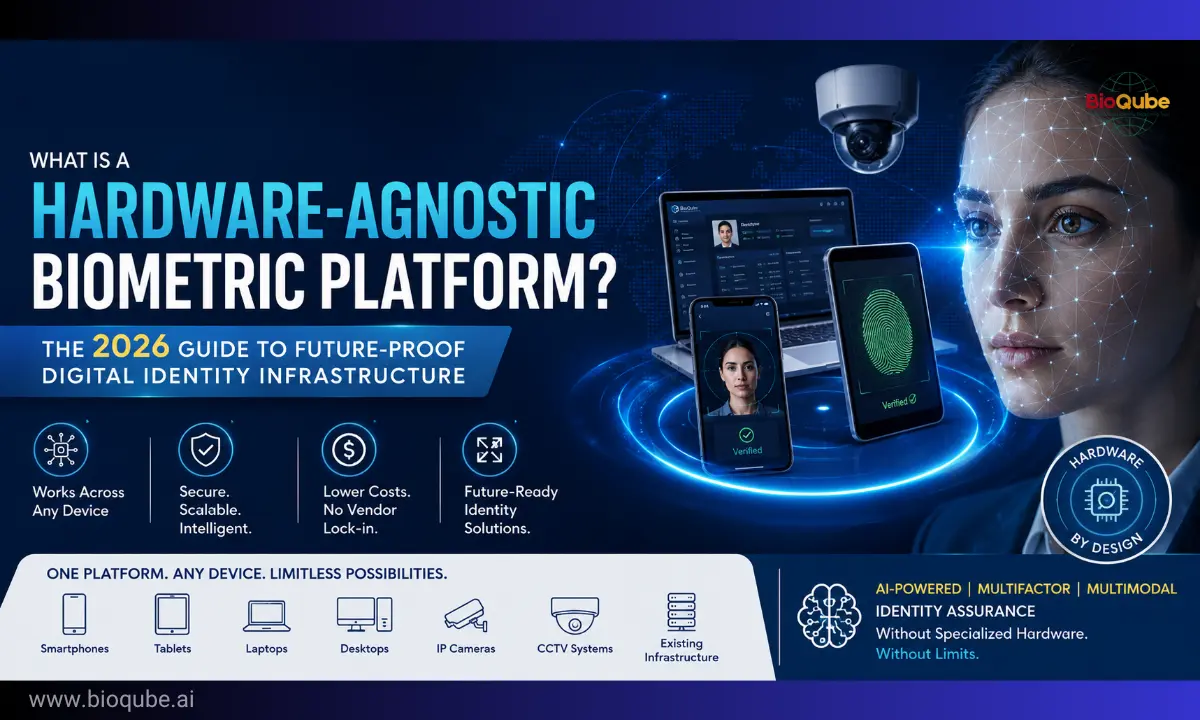
As governments, enterprises, border agencies, financial institutions, healthcare organizations, and travel operators accelerate digital transformation, biometric identity systems have become a critical component of secure authentication and identity verification.
However, many organizations face a significant challenge: biometric solutions often depend on specific hardware devices, creating vendor lock-in, scalability limitations, and costly infrastructure upgrades.
This challenge has given rise to a new generation of biometric technology known as a Hardware-Agnostic Biometric Platform.
In 2026, organizations are increasingly seeking biometric solutions that can operate seamlessly across smartphones, tablets, laptops, desktops, IP cameras, CCTV systems, biometric scanners, and future devices without requiring costly hardware replacements.
A hardware-agnostic architecture provides the flexibility, scalability, and interoperability needed to support modern digital identity ecosystems.
This guide explores what a hardware-agnostic biometric platform is, how it works, its advantages, and why it is becoming a strategic requirement for governments and enterprises worldwide.
Table of Contents
What is a Hardware-Agnostic Biometric Platform?
A hardware-agnostic biometric platform is a biometric identity system designed to function independently of specific hardware manufacturers, devices, sensors, or operating environments.
Instead of being tied to proprietary fingerprint scanners, facial recognition cameras, iris readers, or attendance devices, the platform can capture, process, authenticate, and verify biometric data across multiple hardware environments through a unified identity framework.
Simply put:
A hardware-agnostic biometric platform enables organizations to use the biometric devices they already own while maintaining a consistent identity verification experience across all channels.
This approach eliminates dependency on a single vendor and allows organizations to scale identity services without replacing their existing infrastructure.
Why Traditional Biometric Systems Create Challenges
Many legacy biometric systems were designed around dedicated hardware devices.
Examples include:
- Proprietary fingerprint terminals
- Dedicated facial recognition cameras
- Vendor-specific attendance systems
- Fixed access control devices
- Closed biometric ecosystems
While these systems can perform well in isolated environments, they often create long-term operational challenges.
Common Limitations
Vendor Lock-In
Organizations become dependent on a single hardware manufacturer for upgrades, maintenance, and expansion.
High Infrastructure Costs
Expanding biometric capabilities often requires purchasing additional proprietary hardware.
Limited Interoperability
Different devices may not communicate effectively across departments or locations.
Scalability Constraints
Deploying biometric services across multiple regions becomes increasingly complex.
Technology Obsolescence
Organizations must frequently replace hardware to access new capabilities.
How a Hardware-Agnostic Biometric Platform Works
A hardware-agnostic platform separates biometric intelligence from physical devices.
Instead of embedding identity processing directly into hardware, biometric matching, authentication, liveness detection, fraud prevention, and analytics are managed through a centralized software layer.
The platform connects with:
- Smartphones
- Tablets
- Desktop computers
- Laptops
- CCTV systems
- IP cameras
- Fingerprint scanners
- Palm scanners
- Voice-enabled devices
- Existing access control infrastructure
This allows organizations to maintain a single identity ecosystem while supporting multiple biometric modalities and deployment environments.
Key Components of a Hardware-Agnostic Biometric Platform
Multi-Modal Biometric Engine
Modern identity systems require flexibility.
A hardware-agnostic platform should support multiple biometric modalities, including:
- Face Recognition
- Fingerprint Recognition
- Palm Recognition
- Voice Biometrics
- Eye Recognition
This ensures organizations can deploy the most appropriate authentication method for each use case.
Device Independence Layer
The platform should integrate seamlessly with various device manufacturers and sensor technologies.
This layer enables organizations to onboard new hardware without redesigning their identity infrastructure.
AI-Powered Identity Verification
Artificial Intelligence enhances accuracy, security, and fraud detection.
Advanced biometric platforms incorporate:
- Identity verification
- Biometric matching
- Behavioral analysis
- Risk assessment
- Fraud detection
- Identity assurance
Liveness Detection and Anti-Spoofing
As deepfakes and synthetic identity attacks increase, organizations require sophisticated security measures.
Modern biometric platforms must include:
- Passive liveness detection
- Active liveness detection
- Deepfake detection
- Presentation attack detection (PAD)
- Injection attack detection
- Identity fraud prevention
Real-Time Analytics
Organizations increasingly require actionable insights from biometric interactions.
Analytics capabilities help monitor:
- Authentication success rates
- Fraud attempts
- Enrollment quality
- User behavior patterns
- Security incidents
Benefits of a Hardware-Agnostic Biometric Platform
Future-Proof Infrastructure
Organizations can adopt emerging technologies without replacing existing systems.
This protects long-term investments while supporting innovation.
Reduced Total Cost of Ownership
By leveraging existing devices and infrastructure, organizations significantly reduce:
- Hardware acquisition costs
- Maintenance expenses
- Deployment complexity
- Upgrade requirements
Faster Deployment
Organizations can implement biometric services across multiple locations without waiting for specialized hardware installations.
Improved User Experience
Users can verify their identity using devices they already possess, including smartphones, tablets, and laptops.
This reduces friction and improves adoption rates.
Enhanced Security
Combining multiple biometric modalities with advanced fraud prevention capabilities creates stronger identity assurance than single-device authentication systems.
Real-World Applications
Border Security and Immigration
Border authorities require flexible biometric systems capable of supporting:
- eGates
- Mobile verification
- Visa processing
- Watchlist screening
- Traveler identity verification
A hardware-agnostic platform enables biometric verification across airports, seaports, land crossings, and remote enrollment environments.
Digital Identity Programs
National identity initiatives increasingly require scalable infrastructure capable of supporting millions of citizens.
Hardware-independent platforms simplify:
- Citizen enrollment
- Identity verification
- Service delivery
- Benefit distribution
Banking and Financial Services
Financial institutions use hardware-agnostic biometrics for:
- Digital onboarding
- Remote account opening
- KYC compliance
- Transaction authentication
- Fraud prevention
Healthcare
Healthcare organizations can verify patient identities using existing devices while improving security and patient experience.
Education
Universities and educational institutions use biometric verification for:
- Student onboarding
- Examination authentication
- Attendance management
- Digital credential verification
Hardware-Agnostic vs Hardware-Dependent Biometric Platforms
| Feature | Hardware-Agnostic Platform | Hardware-Dependent Platform |
|---|---|---|
| Device Flexibility | High | Limited |
| Vendor Independence | Yes | No |
| Scalability | Excellent | Moderate |
| Upgrade Costs | Low | High |
| Future Readiness | Strong | Limited |
| Multi-Modal Support | Extensive | Often Restricted |
| Cloud Integration | Native | Variable |
| Deployment Speed | Fast | Slower |
Why Hardware-Agnostic Biometrics Matter in 2026
The digital identity landscape is evolving rapidly.
Organizations are facing:
- AI-generated identity fraud
- Deepfake attacks
- Remote onboarding risks
- Cross-border identity challenges
- Expanding digital service ecosystems
A hardware-agnostic biometric platform provides the agility required to address these challenges while maintaining security, scalability, and operational efficiency.
As biometric adoption expands across governments, enterprises, and critical infrastructure sectors, organizations that remain dependent on proprietary hardware ecosystems may struggle to adapt to future identity requirements.
How BioQube Delivers Hardware-Agnostic Biometric Innovation
At BioQube, we believe identity should not be constrained by hardware limitations.
Our AI-powered biometric identity platform is designed to operate across a wide range of devices and environments, enabling organizations to build secure, scalable, and future-ready digital identity ecosystems.
BioQube’s platform supports:
- Face Recognition
- Fingerprint Recognition
- Palm Recognition
- Voice Biometrics
- Eye Recognition
across:
- Smartphones
- Tablets
- Laptops
- Desktops
- IP Cameras
- CCTV Systems
- Existing Enterprise Infrastructure
This enables governments, border agencies, financial institutions, healthcare providers, educational organizations, and enterprises to deploy advanced biometric identity services without costly hardware dependencies.
Explore related solutions:
- BioKYC for secure digital onboarding and identity verification
- BioVisa for trusted visa processing and traveler authentication
- IdenTrip for seamless traveler identity management
- Border Security Solutions for advanced identity assurance and security operations
- National Biometric ID Registration for large-scale citizen identity programs
Conclusion
The future of digital identity is not tied to a single device, sensor, or manufacturer. Organizations require flexible, scalable, and intelligent identity platforms capable of adapting to rapidly evolving security threats and operational requirements.
A hardware-agnostic biometric platform empowers organizations to maximize existing investments, accelerate deployment, improve user experiences, and strengthen identity assurance across every touchpoint.
As digital identity ecosystems continue to expand in 2026 and beyond, hardware-agnostic biometrics will become a foundational requirement for secure and future-ready identity infrastructure.

About the Author
This article was developed by the BioQube Research & Innovation Team, specializing in AI-powered digital identity, multifactor biometrics, border security, immigration technology, digital onboarding, and national identity infrastructure.
BioQube’s patented hardware-agnostic biometric platform enables secure identity verification across smartphones, tablets, laptops, desktops, IP cameras, CCTV systems, and existing enterprise infrastructure, helping governments and organizations build scalable and future-ready identity ecosystems.
Frequently Asked Questions (FAQ)
What does hardware-agnostic mean in biometrics?
Hardware-agnostic means a biometric platform can operate across multiple devices, sensors, and hardware manufacturers without being restricted to a single vendor ecosystem.
Why is hardware-agnostic biometrics important?
It reduces vendor lock-in, lowers costs, improves scalability, and enables organizations to future-proof their identity infrastructure.
Can hardware-agnostic platforms support multiple biometric modalities?
Yes. Modern platforms can support facial recognition, fingerprints, palm recognition, voice biometrics, and eye recognition through a unified identity framework.
Is a hardware-agnostic platform more secure?
When combined with AI-powered fraud detection, liveness detection, presentation attack detection, and injection attack detection, hardware-agnostic platforms can provide stronger security and identity assurance.
Which industries benefit most from hardware-agnostic biometrics?
Government, border security, banking, healthcare, education, travel, aviation, and enterprise sectors benefit significantly from hardware-independent biometric systems.


