
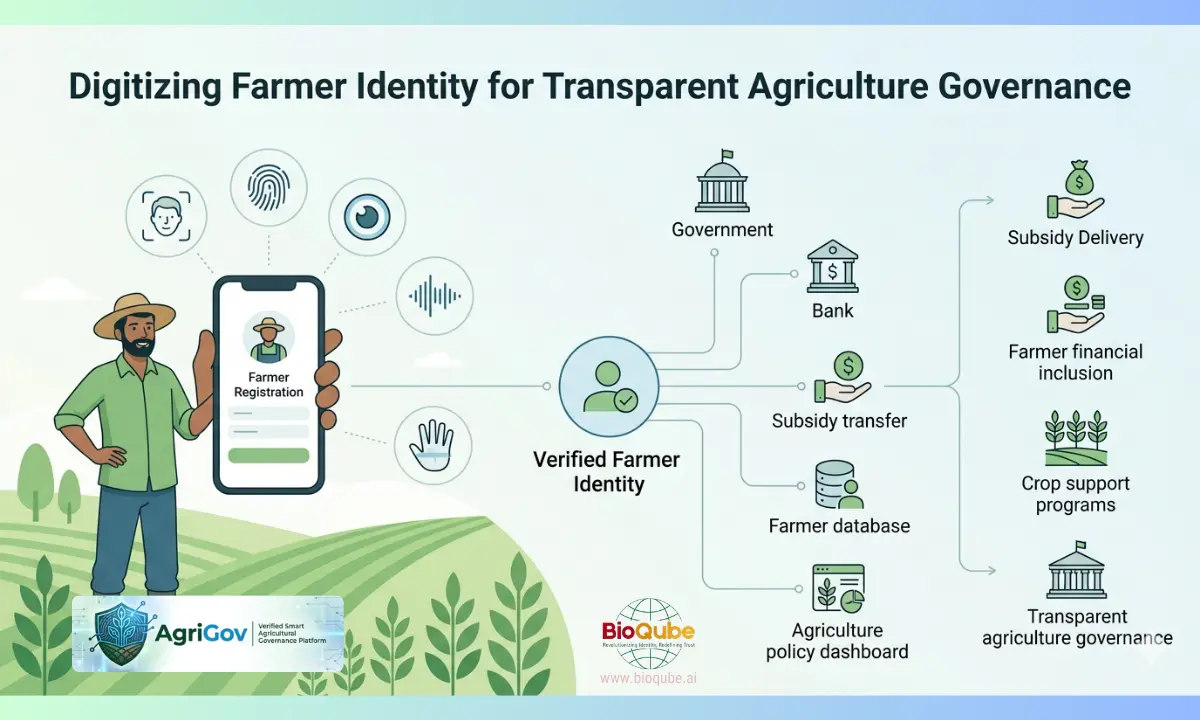
Digital identity infrastructure in agriculture refers to a secure, scalable system that uniquely verifies farmers, tracks agricultural activities, and enables transparent delivery of subsidies, credit, and services using biometric and AI technologies.
Agriculture feeds the world. It sustains economies, supports livelihoods, and remains the backbone of many developing nations.
Yet, despite its importance, one of the most critical stakeholders in this ecosystem, the farmer often remains invisible within national digital systems.
This invisibility is not just a technological gap. It is a systemic governance challenge that affects how governments design policies, distribute subsidies, and enable financial inclusion.
As nations accelerate toward digital transformation, a fundamental question emerges:
Can agriculture truly evolve without first establishing a trusted digital identity for farmers?
Table of Contents
The Global Farmer Digital Identity Infrastructure Gap
Across the world, millions of farmers operate outside formal digital systems.
They lack:
• Verified identity records
• Inclusion in centralized agricultural databases
• Access to structured financial services
• Visibility in policy frameworks
In many countries, farmer data still exists in fragmented formats; paper records, local registries, or siloed databases. This lack of a unified and verified digital identity infrastructure system creates inefficiencies that ripple across the entire agricultural value chain.
Without a reliable way to identify farmers, governments cannot effectively answer critical questions:
Who are the actual beneficiaries of agricultural subsidies?
Which farmers need financial assistance the most?
How can policies be tailored to real-time agricultural conditions?
The absence of these answers results in policy inefficiencies, misallocation of resources, and limited impact of government programs.
The Cost of Invisibility: Subsidy Leakages and Policy Failures
Governments worldwide invest billions of dollars annually in agricultural subsidies, welfare schemes, and rural development programs.
However, without verified farmer digital identity infrastructure systems, these investments often face structural challenges:
Subsidy Leakages:
Duplicate or fake beneficiaries divert funds away from genuine farmers.
Ghost Beneficiaries:
Outdated or unverified records allow non-existent individuals to remain in the system.
Inefficient Distribution:
Manual verification processes delay the delivery of benefits.
Limited Accountability:
Governments struggle to track the effectiveness of subsidy programs.
The result is not just financial loss – it is a loss of trust in agricultural governance systems.
Financial Exclusion: The Hidden Barrier
Beyond subsidies, the lack of verified farmer identity creates another critical challenge: financial exclusion.
Financial institutions require reliable digital identity verification to extend:
• Agricultural loans
• Crop insurance
• Credit facilities
Without trusted digital identity infrastructure systems, farmers are often unable to access formal financial services. This forces many into informal lending channels, increasing their financial vulnerability.
In essence, digital identity is the gateway to financial inclusion.
Without it, farmers remain disconnected from the very systems designed to support them.
The Missing Layer in Digital Public Infrastructure
Over the past decade, many countries have invested in Digital Public Infrastructure (DPI), building foundational systems for identity, payments, and data exchange.
These systems have transformed sectors such as:
• Banking
• E-commerce
• Social welfare distribution
However, agriculture has largely remained outside this transformation.
While sectors like finance have adopted digital identity infrastructure, agriculture still relies heavily on manual processes and fragmented data systems.
This reveals a critical gap:
Agriculture lacks a dedicated digital identity infrastructure.
Without this foundational layer, even the most advanced agricultural technologies cannot achieve their full potential.
Reimagining Agriculture Through Digital Identity Infrastructure
To address this gap, governments must rethink agriculture governance from the ground up.
At the center of this transformation lies a simple but powerful concept:
Every farmer should have a secure, verifiable digital identity.
A digital farmer identity system can serve as the foundation for:
• Accurate farmer registration
• Transparent subsidy distribution
• Financial inclusion
• Data-driven agricultural policies
By establishing a trusted identity layer, governments can create a connected agricultural ecosystem where farmers, institutions, and policymakers operate on a single source of truth.
From Identity to Intelligence: The Power of Integrated Systems
Digital identity is not just about verification – it is about enabling intelligence.
When combined with data analytics, a digital farmer digital identity system can unlock powerful insights:
• Crop patterns and productivity trends
• Regional agricultural performance
• Climate impact on farming
• Resource allocation efficiency
This enables governments to move from reactive policymaking to proactive governance.
Instead of relying on outdated or incomplete data, policymakers can make informed decisions based on real-time insights.
Enabling Transparent and Inclusive Agriculture
One of the most transformative impacts of digital identity in agriculture is transparency.
With verified farmer identities:
• Subsidies can be delivered directly to intended beneficiaries
• Fraudulent activities can be minimized
• Program outcomes can be tracked more effectively
At the same time, digital identity promotes inclusion.
Smallholder farmers, who often operate on the margins of formal systems, gain access to:
• Financial services
• Insurance products
• Government support programs
This creates a more equitable agricultural ecosystem where opportunities are not limited by access to identity.
Also Read, Why Hardware-Dependent Biometrics Are No Longer Viable?
The Role of Platforms Like AgriGov
As the need for digital identity infrastructure in agriculture becomes more evident, platforms like AgriGov are emerging to address this challenge.
AgriGov is designed to help governments:
• Register and verify farmers using secure multifactor biometric identity
• Build centralized digital farmer registries
• Enable transparent subsidy distribution
• Integrate financial and insurance ecosystems
• Generate real-time agricultural intelligence
By combining biometric identity, data analytics, and governance frameworks, AgriGov provides a scalable solution for modern agricultural systems.
More importantly, it aligns with the broader vision of Digital Public Infrastructure, extending its benefits to the agricultural sector.
A Strategic Imperative for Governments
The transformation of agriculture is no longer optional, it is a strategic necessity.
As global challenges such as climate change, food security, and rural development intensify, governments must adopt systems that are:
• Transparent
• Scalable
• Data-driven
• Inclusive
Digital farmer digital identity infrastructure is not just a technological upgrade. It is a governance reform that can redefine how agricultural systems operate.
The Road Ahead
The future of agriculture will not be defined solely by advancements in machinery, irrigation, or crop science.
It will be shaped by how effectively we connect farmers to digital ecosystems.
This begins with identity.
A farmer who is visible, verified, and connected becomes:
• A participant in the digital economy
• A beneficiary of targeted policies
• A contributor to data-driven agriculture
In contrast, a farmer without identity remains excluded from progress.
Conclusion: From Invisible to Empowered
The invisible farmer crisis is one of the most overlooked challenges in global agriculture.
Yet, it is also one of the most solvable.
By investing in digital identity infrastructure, governments can unlock:
• Transparency in subsidy systems
• Inclusion in financial services
• Efficiency in policy implementation
• Intelligence in agricultural planning
Platforms like AgriGov represent a step toward this future, where every farmer is not just counted, but empowered.
Because in the end, transforming agriculture is not just about technology.
It is about ensuring that the people who feed the world are recognized, verified, and included in the systems that shape their future.